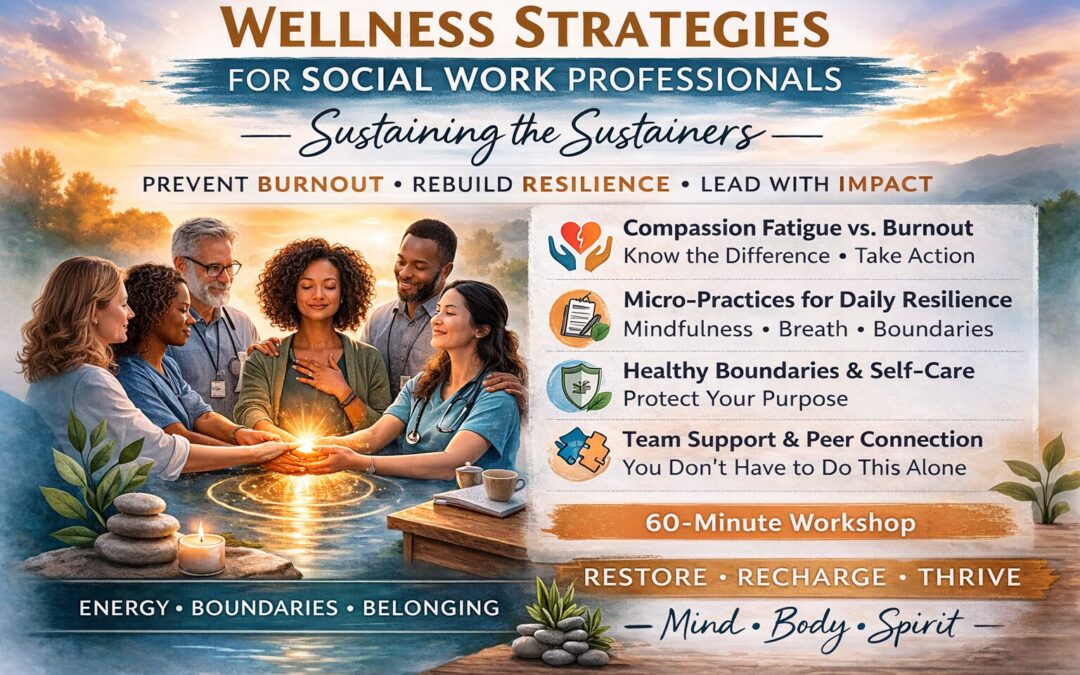
Social work calls for deep compassion, steady presence, and relentless care for others. This often comes at the expense of one’s own well-being. This 60-minute workshop creates space to name the difference between compassion fatigue and burnout, normalize the weight social workers carry, and offer practical ways to restore harmony without guilt. Participants will explore simple, realistic micro-practices that support resilience, strengthen healthy boundaries, and protect the purpose that drew them to this work in the first place. Because sustaining the mission starts with sustaining the people doing the work.
While this is definitely open to everyone (because wellness impacts us all), the emphasis will be on highlighting professionals in social work/social services to recognize March as Social Work Awareness Month.
Most organizations today can point to a wellness policy. Flexible work statements. Employee assistance programs. Mental health days. Well-being commitments proudly displayed on websites and in handbooks.
And yet, employees often tell a different story.
So what causes the gap between wellness policies and actual practice?
It’s rarely a lack of good intentions. More often, it’s a breakdown between what leaders say they value and how work is truly designed and rewarded.
Wellness Is Declared But Not Operationalized
One of the biggest causes of the gap is that wellness lives at the level of language, not systems. Policies exist, but they are not embedded into performance expectations, workflows, or leadership behaviors.
When productivity metrics reward overwork, speed, and constant availability, wellness policies become optional in practice—even if they’re mandatory on paper. Employees quickly learn what really matters by watching what gets praised, promoted, and protected.
Culture always outperforms policy.
Leadership Behavior Sends Mixed Signals
Another critical factor is leadership modeling. Leaders may support wellness conceptually, but their actions often communicate something else.
When leaders:
Regularly work late and expect rapid responses
Cancel time off or discourage disconnecting
Treat burnout as a personal weakness rather than a system issue
Employees receive a clear message that says wellness is encouraged, but only if it doesn’t interfere with output. This inconsistency erodes trust and widens the gap between stated values and lived experience.
Workload Design Undermines Well-Being
You cannot wellness-program your way out of an unsustainable workload.
Many organizations offer wellness benefits while simultaneously operating with understaffed teams, unclear priorities, and constant urgency. In these environments, employees don’t lack wellness resources—they lack capacity.
When work is designed without margin, wellness becomes another task to manage rather than a condition that supports performance.
Accountability Stops Short
Wellness often lives in HR or internal communications, but accountability rarely reaches senior leadership or people managers. When leaders are not evaluated on how they support sustainable performance, wellness remains peripheral.
Bridging the gap requires asking harder questions:
Are leaders trained to lead people, not just results?
Are managers supported in setting boundaries and prioritizing well-being?
Are there consequences for behaviors that consistently undermine wellness?
Without accountability, policies become promises without power.
Closing the Gap Requires Alignment
The gap between wellness policy and practice closes when organizations align values, behaviors, and systems. That means designing work that allows people to recover, training leaders to lead with clarity and care, and measuring success beyond short-term output.
Wellness is not a perk. It’s a performance strategy.
Organizations that understand this don’t just retain talent—they build resilient, engaged, and high-performing teams.
This is the work of leadership in transition.
If this sounds like a topic occurring within your business or organization, I welcome the opportunity to explore ways we can work together.
For many leaders, boundaries feel like a contradiction. We’re taught, often implicitly, that strong leadership means being always available, saying yes, pushing harder, and carrying the weight for everyone else. The unspoken fear is this: If I slow down or draw lines, performance will suffer.
In reality, the opposite is true.
Leaders who set clear, healthy boundaries don’t dilute performance. They protect it.
Modeling Boundaries Gives Permission
Leadership is always louder than policy. When leaders respond to emails at all hours, skip breaks, or normalize overload, teams may perceive boundaries as optional or unsustainable. Demonstrating consistent boundary-setting reinforces their importance and builds credibility.
But when leaders model boundaries, block time for focus, honor time off, and set meeting norms, they send a powerful signal: Well-being and performance are not just compatible but mutually reinforcing, fostering trust and safety within the team.
That signal builds trust. And trust accelerates performance.
Boundaries Strengthen Accountability
Contrary to popular belief, boundaries don’t lower expectations. They sharpen them.
When leaders are clear about scope, timelines, and responsibilities, teams know exactly where ownership begins and ends. This reduces confusion, minimizes rework, and allows people to perform at their best without second-guessing or overextending.
Boundaries make accountability fair—and fairness fuels engagement, motivating teams to invest their best efforts with confidence and clarity.
Sustainable Performance Is the Goal
In today’s workplace across healthcare, corporate, nonprofit, and hybrid environments, leaders who prioritize longevity and well-being will build resilient teams that can adapt and succeed over time.
Setting boundaries is not stepping back from leadership. It’s stepping into it.
When leaders establish clear boundaries, they create space for focus, alignment, and resilience. And that’s how teams don’t just perform. They thrive.
If this sounds like a topic occurring within your business or organization, I welcome the opportunity to explore ways we can work together.
Burnout rarely arrives with a dramatic announcement. It doesn’t always look like exhaustion, tears, or someone saying, “I can’t do this anymore.” More often, burnout shows up quietly—camouflaged as competence, commitment, or compliance.
And that’s why so many of its signals are either missed, minimized, or misinterpreted.
When someone is always “on,” always available, and always carrying more than their share, burnout may already be in motion. Others may appreciate the behavior, but the depletion behind it goes unseen.
Withdrawal Is Often Misread as Disengagement
Burnout doesn’t always look like stress—it can look like distance.
Employees experiencing burnout may:
Speak less in meetings
Stop offering ideas or feedback
Decline optional opportunities
Do exactly what’s asked—and nothing more
These behaviors are often labeled as disengagement or attitude problems, when they may actually be signs of emotional exhaustion and self-protection.
Burnout doesn’t always push people out. Sometimes it causes them to pull back.
These behaviors are often labeled as disengagement or attitude problems, when they may actually be signs of emotional exhaustion and self-protection.
Burnout doesn’t always push people out. Sometimes it causes them to pull back.
Irritability Gets Labeled as a Personality Issue
Short tempers, impatience, and decreased tolerance are frequently misinterpreted as personal shortcomings rather than signals of overload.
When stress is chronic, emotional regulation becomes harder. Leaders who overlook this context may address behavior without addressing the conditions creating it—missing an opportunity for real intervention.
Absences Are Treated as Isolated Events
Increased sick days, frequent appointments, or last-minute time off can be early indicators of burnout. Too often, these patterns are viewed in isolation instead of as part of a larger wellness picture.
Burnout affects the body as much as the mind. When organizations fail to connect the dots, they address symptoms rather than sources.
Silence Is the Loudest Signal
Perhaps the most dangerous signal of burnout is silence.
Employees stop asking for help when they believe it won’t change anything—or when they fear the consequences of being honest. A lack of complaints is not proof of well-being. It may be evidence of resignation.
Leaders who equate quiet with contentment often discover the truth too late—during an unexpected resignation or performance decline.
Why Leaders Miss the Signals
Burnout signals are missed not because leaders don’t care, but because systems normalize urgency, reward endurance, and undervalue recovery. When pressure becomes standard, warning signs blend into the background.
But leadership requires discernment—not just output tracking.
Seeing What Matters
Identifying burnout early means paying attention to patterns, not just performance. It means asking better questions, creating psychological safety, and designing work that allows people to recover, not just produce.
Burnout is not a personal failure. It’s a leadership and systems challenge.
Leaders who learn to recognize the subtle signals don’t just prevent burnout. They protect performance, trust, and longevity. That’s how organizations truly transition, transform, and thrive.
If this sounds like a topic occurring within your business or organization, I welcome the opportunity to explore ways we can work together.
When teams are under pressure, budgets tighten, and leaders are asked to do more with less, one of the first “soft” initiatives that gets cut is psychological safety. There is a belief that team members can speak up, ask questions, and admit mistakes without fear of negative consequences.
But there’s a leadership paradox most organizations miss that is extremely important. In the toughest times, psychological safety doesn’t become less important. It actually becomes essential.
What Psychological Safety Really Is
At its core, psychological safety means that people feel secure enough to contribute their thoughts, raise concerns, and offer ideas — even when those ideas push back against the status quo. It’s not about being “nice.” It’s about creating an environment where candor, risk taking, and authentic dialogue are normalized.
Why Many Leaders Treat It as a Luxury
When resources are strained, organizations often shift focus to tactical training programs or performance metrics, assuming that psychological safety can wait. But research from faculty including Harvard Business Review scholars shows that this perspective is flawed.
During times of stress, uncertainty, or transformation, the ability to speak up safely becomes one of the strongest protective forces against burnout, dysfunction, and turnover. In fact, employees who reported feeling safe speaking up before the crisis hit were more resilient during the crisis.
What’s at Stake When Safety Is Ignored
When psychological safety is absent, teams don’t just experience surface-level discomfort. Their nervous systems switch into protection mode. People hold back ideas, withhold feedback, and default to compliance instead of collaboration. The results include:
burnout climbs
trust erodes
innovation stalls
turnover spikes
These outcomes aren’t abstract HR metrics. They directly impact organizational performance, sustainability, and resilience.
Psychological Safety as a Social Resource
One of the most powerful findings from recent research: psychological safety functions like a social resource. When people feel safe to speak up, even in small ways, it creates a ripple effect of support, shared problem-solving, and mutual trust that helps teams endure turbulence.
This means:
People don’t just survive tough times. They navigate them with agency and confidence.
Leaders get real, actionable information before problems become crises.
Organizations cultivate resilience, retention, and strategic adaptability.
What Great Leaders Do Differently
High-performing, future-ready leaders don’t treat psychological safety as a checkbox. They treat it as an operating system woven into how teams communicate, respond to failure, and make decisions. They model vulnerability and learning. They invite and value dissenting views. They normalize candid conversations, protect time and focus for meaningful dialogue. This isn’t about comfort. This is about performance under pressure.
The Leadership Imperative in 2026 and Beyond
In today’s complex work environment where economic uncertainty, talent shortages, and rapid change are the norm, psychological safety isn’t optional. It’s a fundamental leadership requirement for building trust, supporting wellness, and unlocking organizational potential. Simply put: If your organization isn’t intentionally cultivating psychological safety, you are managing symptoms for the potential of deeper dysfunction. And that’s not leadership. That’s maintenance.